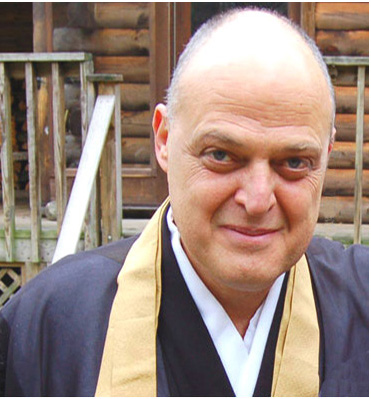
Genro
Lee Milton, Sensei is the resident teacher and abbot of
Endless Mountain Zendo. His formal Zen studies began in 1976 with Eido
Shimano Roshi of The Zen Studies Society by whom he was ordained and
trained as a Zen monk in the Rinzai Zen tradition. Genro served as
resident director of New York Zendo, Shobo-ji in
New York City
(1981-1988) and Plum Tree Zendo in
Philadelphia
(1988-1998). He came to
Stillwater
in 1998 to establish Endless Mountain Zendo. In a ceremony conducted by
Jiro Andy Afable Osho of Wild Goose Zendo, Genro was acknowledged as a
Dharma teacher within the Rinzai Zen school. Genro has also presented
Zen to many academic, religious and special interest groups.
Message from Genro:
Who
Dreams?
We go to sleep and a dream appears. It could be anything: Familiar and
unfamiliar people come and go and interact with us. We may see
landscapes, cities, distant galaxies, or a busy market place. We
converse and we react to things that are said and done, and we may
experience emotions of fear, happiness, love, or hatred - anything is
possible. From our point of view, the scene has color, sound, depth and
breadth. And, as in our wakeful consciousness, we experience the people
and places of our dream as separate from ourselves. We haven't a clue
what will happen next and - the beings we encounter are unpredictable.
We can't see into the minds of our dream companions. They seem to
operate independently of us just as in daily life. And then we wake up
and think, "I had a dream."
We've just experienced a 3-dimensional world with color, sound, and
feeling. We've experienced the relationship of subject-object - the
dreamer and the dreamed.
But if we look at our dream and ask, "Where did that dream happen?" we
realize, in spite of appearances, that it happened nowhere. Our dream
had no dimension or location. The solidity of the dream beings and
places we experienced were equally insubstantial. When awake, we know
that our dreams are baseless and empty. We know the sound and color was
pure imagination with no vibration, physical light or spectrum - No ear
to hear or eye to see. And if we ask, "What about our perception that
there were others, that
there were people and places outside our self?" we can see that the
"others" in our dream were not separate from us at all. They were our
mind. They happened in one consciousness, an indivisible mind
perception. It played out in a colorless, soundless, dimensionless
consciousness where separation
cannot be. And all that happened in this dream happened without effort
or struggle; all was weightless, empty and spontaneously born in
emptiness. Without doer or volition, things were done and someone or
something appeared to do it. All was absolutely convincing.
So it is now in this world of wakefulness. All is absolutely convincing.
We look out into the world and are conscious of it, but we feel that we
are visitors in a place external to ourselves. We can see it, hear it,
feel it and occupy space within it, and only to that degree do we
experience integration. But the twain between self and others, we
think, can never meet. The division of things is fundamental to our
ordinary way of
perceiving things, and we accept the reality and solidity of experience
without question. We take for granted the view that "I am" and "things
are as they appear to be".
But all is dream, and all that we may say of our sleeping consciousness
is true of the wakeful one. Nothing is fixed in thought or in the
external world. Nothing abides. All is in constant transformation like a
drifting
cloud. Something, a dreamer, imagines a world of depth and breadth, of
sight and hearing, of heat and cold, a pageant of endless possibilities.
Ideas come up, and the dreamer clings to them. It is in this activity of
grasping and holding that a sense of self is born; for an "I" to be,
there must be an "other". Thus, in grasping and naming, the indivisible
essence of Mind is divided into two - here and there, real and unreal,
being and non-being. In naming the manifestations of consciousness and
abiding in this sense of
knowledge, we are lost in its complexity and subject to its fortunes and
misfortunes. As things arise, we, the witnesses, bind ourselves to them,
and, thus, we suffer.
If we doubt that things are as they appear to be the question is, "Then,
what are they?" If we doubt that things are as they appear to be, we
find we cannot resolve our doubt by relying upon the appearances in
question. That is, if we want to know who is behind a mask, it won't
help to keep looking at the disguise. It has to be removed. If
appearances are of no use, discard them: Appearances are all things
known either external or internal. Find the one who dreams and thinks,
the one who is watching, naming and knowing.
Leave thoughts and knowing alone.
If we look into our minds to find the one who is thinking, we will
discover there is no one as such to find, that the essential one is
elusive. But still, something perceives. What is it? In time, we exhaust
our tendencies to seek it in form and reasoned explanations.
See the thoughts and appearances that drift in consciousness as clouds
obscuring the light, and search your mind for their origin. Our habit of
grasping and self-identification is deep and, thus, our efforts at
uprooting must be firm and dedicated. As we investigate, cutting through
the resistance of habit, we become clear and open and our tendencies to
name and grasp weaken. We become aware, having a view independent of the
empty play of thought and phenomena. Long cherished attachments lose
their attraction
and so, too, the suffering and discontent that comes with wandering
about within them. Still, we look dispassionately into mind, discarding
whatever trace appears. The clouds vanish allowing the light to shine
unobstructed. In this light of Wisdom, we discover that there is no one,
no past, no future and no present between. All plays out in emptiness.
This understanding comes all by itself. Life and death are the
insubstantial fabric of dream. All is one Mind. We are the "something"
we have sought for all along.
Ordinarily, we seek special circumstances that bring happiness and
relief from suffering and discontent, and we spend our days struggling
to patch things up. We try to control the flow of things, not realizing
that there is no one in control and that those things happen as they
will. We resist the "what is" of life, and it becomes a battle. We think
we know what we are and we have the knowledge to make our way, however
haplessly, through time. We love and hate and wish to possess things
that we know may slip away. We are fearful beings and jealous. The love
we find causes pain. Happiness and satisfaction are fleeting. It is, to
put it mildly, a precarious dream.
The things we find the deepest joy in are the things that bear some
indication of a greater truth. They are those things that hint of
something profound, that shake us from our habitual self-centeredness to
reveal a
taste of the unconditional. In these moments we forget ourselves and,
perhaps, intuit the truth that all things are united and feel a sense of
transcendent compassion or have a glimpse of wisdom that wakes us up for
at least a moment. These are gaps in the play of form, gaps that
indicate that things are not what they seem. In whatever way these gaps
and glimpses come, they are pure grace, the grace of the unknowable. If
you wish to know your true teacher, your guru, listen to its wordless
voice. Look into the gaps. Find the dreamer.
May
All Beings Attain True Peace

Endless
Mountain Zendo, 104 Hollow Road, Stillwater, PA 17878
Home
•
The Zendo
•
Programs
•
Beginner's Zen
•
Calendar
•
Teacher
Membership
•
Donations
•
Store
•
Scrap Book
•
Reach Us